
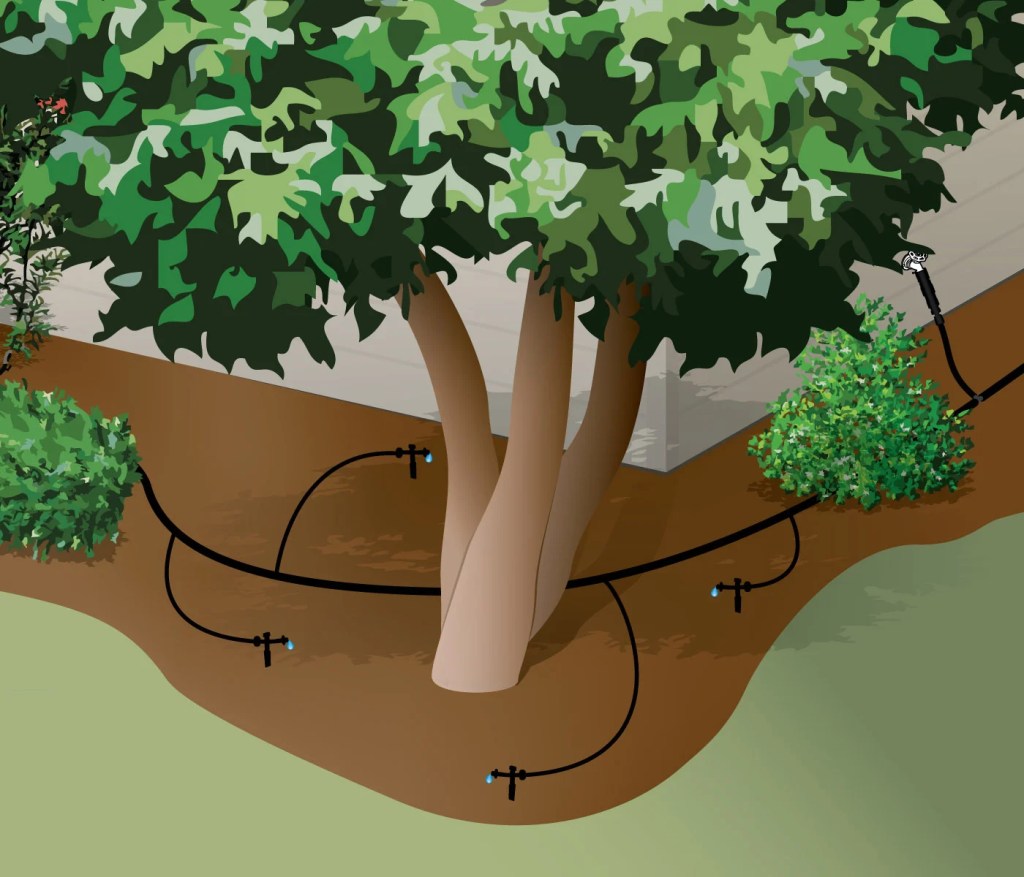
What is the most important factor in a making successful garden or farm? It is soil health – and how you water is one of the most important strategies in building a healthy soil.
Why is soil health important? Preserving soil nutrients, and nurturing mycorrhizae and other beneficials like earthworms. The word “mycorrhiza”. To be more specific, mycorrhizae (mai·kuh·rai·zee), which means “fungal root” are fungi that have a symbiotic relationship with the roots of many plants.
How does watering method affect plants? Surface sprinklers and flood irrigations cause evaporation, runoff, splashing, leaf burn, pests and disease growth, high humidity problems (like on citrus), nutrient depletion, shallow roots, salt buildup in root zone, soil compaction, encourages weeds, and encourages slugs
What is Drip Irrigation and how was it developed? The origins go back to ancient China where unglazed clay pots were partially buried and filled with water. This method is still used today in the deserts of the middle east and was formalized in In the 1930s by Polish-born Simcha Blass, an engineer who co-founded Israel’s national water company, which provided water for irrigation in Israel’s desert.
How does drip irrigation benefit us? It puts water directly to roots not leaves, only applies water only as fast as soil can accept it, opens up the soil and allows roots to breath, encourages beneficial organisms, goes deep for deep roots, preserves soil nutrients, pushes salts past root extensions, discourages weeds, discourages pests and diseases, and can be covered with mulch.
How does mulch help plants? Mulch not only keeps the moisture from evaporating too rapidly, but it also keeps the roots cool and makes a happy home for earthworms and the beneficial microbes that feed the plants. Earthworms will eat the decomposing organic matter and carry it down into the root zone, aerating the soil and placing their magic “castings” right where the roots can suck them up! The best mulches are organicNOT plastic – those that will breakdown into nutrients and feed the soil. Compost, forest mulch, coconut coir are all great, as is wood chips, however, anything that has not been composted will deprive the plant of nitrogen so adding manures or guanos to these mulches is a good idea. Layer the mulch on heavily enough to smother weeds and retain moisture, but leave a little space around the stems of your plants to curtail stem rot.
Do’s
- Size drippers to the soil type
- Place drippers in root zone but not against stem
- One for small plants, two for shrubs, at least three for trees in a triangle just inside canopy
- Water long enough to push salts below root extensions and encourage deep roots
Don’t
- Water too often
- Use chemical fertilizers especially injectors
- Use Glysophate
- Leave PVC unprotected
 West Maui Wildfire Readiness Ohana
Leave a comment